
What is a CVT Transmission? Many people are unaware of this term, but those who have recently purchased a new car may have heard it. CVT mainly stands for Continuously Variable Transmission, and it is very popularly used in modern vehicles. Compared to traditional transmissions that shift through a fixed number of gears, a CVT provides an infinite number of gear ratios. This might sound complicated, but it actually makes the driving experience smoother, increases efficiency, and improves fuel economy.
Nowadays, new car manufacturers love the CVT because it helps to achieve better fuel economy, which positively impacts the environment and helps manage fuel prices. In this article, we are going to learn everything related to the CVT: how it helps for better fuel consumption, what the common CVT problems are today, and which cars have the best CVT transmissions. Make sure to read this article for a complete understanding.
Understanding CVT Transmission Basics
So, let’s discuss the CVT from the basics. As you know, CVT stands for Continuously Variable Transmission, and it is completely different from the transmissions that most people are familiar with. Instead of having a set number of gears, like a manual transmission which mainly comes in 5 or 6 speeds, or a traditional automatic with 8 or 10 gears, a CVT can seamlessly adjust to provide the perfect gear ratio for driving in any situation, whether you are driving on the highway, in mountainous areas, or on local city streets like riding up a smooth ramp with no steps at all.
The most common benefit of using a CVT nowadays is that your engine can operate at the most efficient RPM. Whether you are accelerating or driving in a local area, this transmission can adjust according to the different situations. This directly reduces the impact on the engine and also helps to save fuel. Compared to a normal transmission, you do not have to change the gear manually in every situation. The CVT automatically adjusts according to the driving situation.
Components of a CVT Transmission
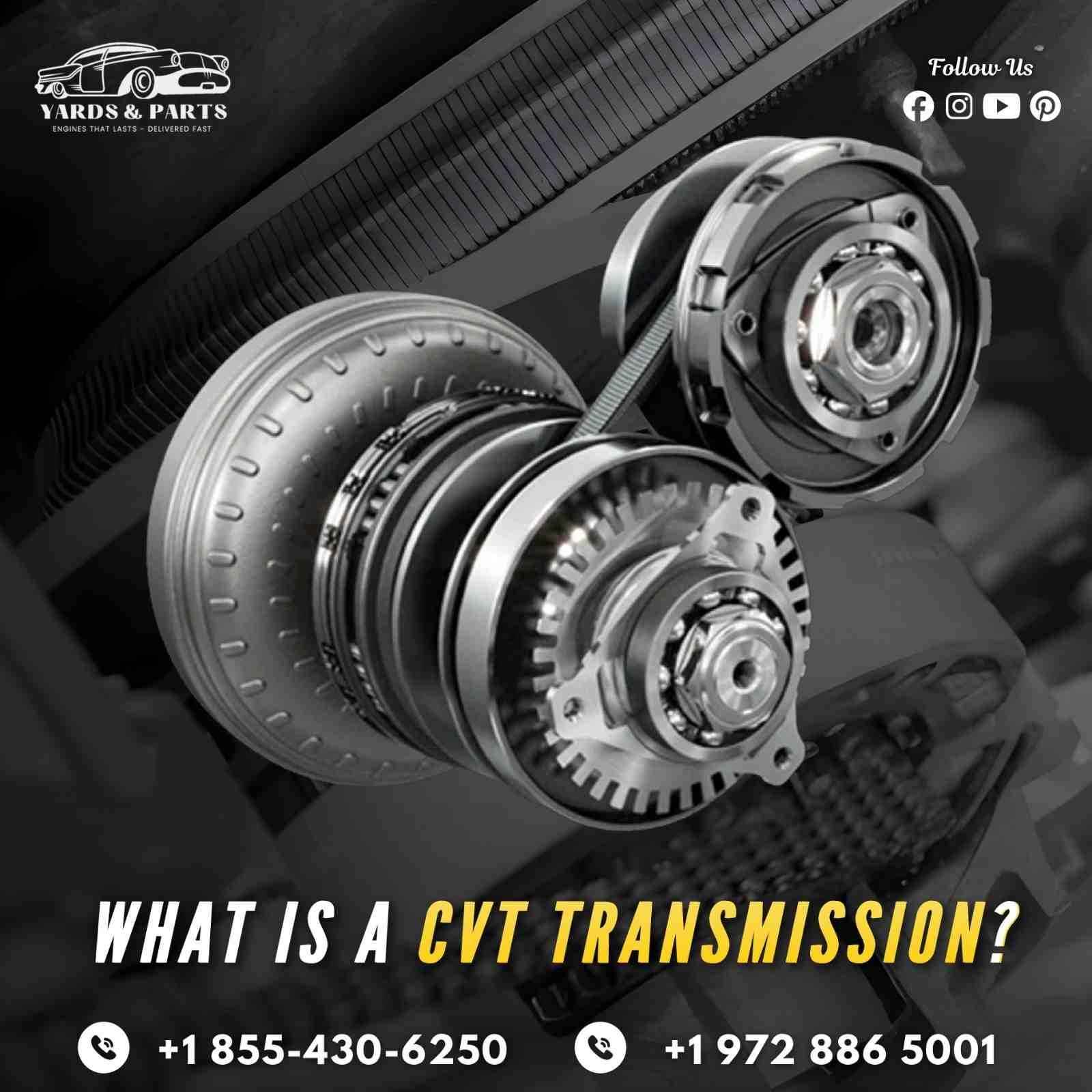
So, let’s understand how a CVT transmission usually works and what its main components are. The primary pulley connects to the engine and receives power from it. This pulley can change its width, which is key to how the CVT operates. Now, let us talk about the secondary pulley. It connects to the wheels and transmits power to them. Like the primary pulley, it can also adjust its width according to the situation and condition.
Between these two pulleys runs either a metal belt or chain. This is not like a normal or regular belt you would find in other cars; these are specially designed to handle high loads and friction. This belt or chain transfers power from the primary pulley to the secondary pulley while constantly adjusting its position based on the pulley widths. The hydraulic system mainly controls the pressure that adjusts the pulley widths.
It uses transmission fluid under pressure to make these adjustments happen smoothly and quickly without creating any problems. Finally, the Control Unit (ECU) is the brain of this operation. It uses a computer to monitor your driving conditions and tells the hydraulic system exactly how to adjust the pulleys to provide the optimal gear ratio for that moment.
How CVT Transmission Works Step by Step
So let us now discuss how a CBT transmission works. When driving, the system works together as follows: when you press on the gas, a control unit determines how much acceleration you want. The control unit then instructs the hydraulic system to adjust the width of pulleys based on how far you pressed down the gas pedal. In isolation, when the primary pulley gets narrower, the secondary pulley gets wider, and vice versa.
As the pulleys change in width, the positioning of the belt or chain changes as well. When the primary pulley gets narrow and the secondary pulley gets wide, you will receive a low gear ratio, which mimics first gear in a conventional transmission; this gives you more acceleration power capability. When the primary pulley gets wide and the secondary pulley gets narrow, you will receive a high gear ratio, which is economical for cruising on the highway.
These changes happen continuously and seamlessly; there are no synchronous gear teeth meshing together to make a “clutch” connection. The CVT blends from one ratio to another with no interruption and allows the engine to run at the optimal RPM for fuel efficiency. The outcome yields smooth acceleration without “shift shock” and/or interruption of power transfer.
Types of CVT Transmissions
Not all CVTs are the same. The most popular design is the pulley CVT, which employs cone-shaped pulleys and a belt or chain system to change the gear ratio. This is what you will see in most cars with CVT transmissions on the market today.
There is also the toroidal CVT, which employs discs and rollers in place of pulleys and belts. These are less common in cars but can support more torque, making them suitable for performance use. They are also more complex and more costly to produce.
In the pulley CVT, there is a split between belt-driven and chain-driven systems. Older CVTs used a specialized metal belt, but newer designs use a chain for greater strength and torque. Chain-driven CVTs can support more power and are more durable, which is why manufacturers are shifting towards this type of CVT.
Advantages of CVT Transmission
The primary benefit of a CVT is fuel efficiency. With a CVT, your engine will always be running at its optimal RPM because the transmission can maintain this. This will give you better gas mileage than a traditional automatic transmission. This is particularly true in city driving, where constant speed changes would normally cause a lot of shifting.
The smooth driving experience is another big benefit. Because there are no traditional gear shifts, the acceleration is seamless and continuous. There is no jerk or pause when the transmission shifts gears because it doesn’t shift gears in the traditional sense.
CVTs are also good at variable speeds. In stop-and-go traffic, a CVT transmission can react instantly to the situation. Because there is less mechanical complexity involved in a CVT than a traditional automatic transmission, there are fewer parts that could potentially go bad. Additionally, a CVT is normally lighter than a traditional automatic transmission, which improves the efficiency of the vehicle.
Disadvantages of CVT Transmission
Although there are benefits to driving a car using a Continuously Variable Transmission (CVT), these transmissions are not without flaws. One common cvt car disadvantage for drivers is that when they accelerate from a stop (pressing the gas pedal), the engine’s Revolution Per Minute (RPM) builds up very rapidly without providing a proportional increase in speed to the car. The reason for this is that the CVT maintains engine RPM at a constant and efficient level while the vehicle gains speed.
When it comes to repairs, the cost of fixing a CVT is typically higher than that of repairing a conventional automatic transmission because of the specialized knowledge and parts necessary to perform the repair. Most mechanics do not possess the same level of training or experience with CVTs due to the limited amount of experience they have had repairing them, and replacement parts may be more expensive.
Additionally, the torque capacity of most CVTs is significantly lower than that of conventional automatic transmissions. Because of this, you will not see a CVT equipped in trucks or performance automobiles built for the purpose of towing large amounts of weight. CVT belt/chain systems do not handle as much power as conventional gear-based automatic transmissions. In addition to the limited torque capacity issue, some CVTs are very loud at high RPMs and many drivers believe that CVTs are not as durable as traditional automatic transmissions.
CVT vs Automatic Transmission – Key Differences
The main difference between CVT vs automatic transmission is in the way they change. A traditional automatic transmission has a fixed number of gear ratios and changes between them in a physical way. A CVT has an infinite number of ratios and changes in a seamless manner.
Regarding fuel efficiency, the CVT has the advantage. A CVT can hold the engine at its optimal speed more easily than a traditional automatic. This could be a difference of 2-4 mpg, depending on the car and driving conditions.
Regarding smoothness, the CVT is continuous in its power transmission. In a traditional automatic, even a very good one, there is a slight pause between gear shifts. Some people like the familiar sensation of gear shifting. Maintenance is different, as a CVT needs CVT fluid, which needs to be changed periodically.
CVT Transmission in Cars – Real-World Applications
Most of the global car manufacturers employ CVT transmissions in their vehicles. Nissan has been a major supporter of CVT transmissions and has employed them in their Altima, Sentra, and Rogue models. Honda employs CVT transmissions in their Civic, Accord, and CR-V models. Subaru has employed CVT transmissions in most of their models, including Outback and Forester. Toyota employs CVT transmissions in most of their models, especially in their compact cars and SUVs.
CVT transmissions are most commonly found in compact cars, especially when fuel efficiency is a concern. They are also used in hybrid cars, where the transmission has to work in tandem with the gas engine and electric motor. Car manufacturers favor CVT transmissions because they help them meet the strict fuel economy and emissions regulations. The driving experience is suited for daily driving, but sports car enthusiasts favor automatic or manual transmissions.
Common CVT Transmission Problems and How to Avoid Them
Like all transmissions, CVTs can experience issues. One of the most common CVT problems with a CVT is a worn belt or chain. Over time, the belt or chain can become worn or stretched, causing it to slip or fail.
Another potential problem is overheating. A CVT may overheat if you’re doing a lot of stop-and-go driving in warm weather or if you’re using the transmission in a way that it wasn’t intended to be used. If a CVT overheats, it can damage internal parts.
Many problems with CVTs are caused by mistakes when maintaining the fluid. If you put the wrong fluid in your transmission or forget to change the fluid when it’s supposed to be changed, it can cause problems. Software problems can also happen. To keep your CVT running longer, you must follow the maintenance schedule to the letter, avoid heavy towing, drive smoothly, and correct any unusual problems right away.
Maintenance Tips for a Long-Lasting CVT Transmission
The most critical thing you can do for your CVT maintenance and reliability is to change the fluid on a regular basis. Most manufacturers recommend that the fluid in your CVT be changed every 30,000 to 60,000 miles. This is not a task you can afford to neglect, as new fluid will keep your transmission cool and well-lubricated.
Avoid heavy towing if your car is not designed for this type of use. CVTs are not built to withstand the stress of towing heavy trailers. Drive your car smoothly and avoid jackrabbit starts and rapid acceleration. Keep your software up to date, as sometimes problems with the CVT can be alleviated by an update in the control software. Pay attention to any unusual noises or symptoms. If your CVT is whining, jerking during acceleration, or hesitating, it is time to have it checked out.
Future of CVT Transmissions in Automotive Industry
The most critical thing you can do for your CVT is to change the fluid on a regular basis. Most manufacturers recommend changing the CVT fluid every 30,000 to 60,000 miles. This is not a task you can afford to put off, as new fluid will keep the transmission cool and well-lubricated.
Avoid heavy towing unless your car is designed for this purpose. CVTs are not built to withstand the rigors of towing heavy loads. Drive smoothly and avoid such things as jackrabbit starts and rapid acceleration. Stay current with software updates from the manufacturer, as sometimes problems with the CVT can be fixed with an updated software control.
Watch for unusual sounds or symptoms. If your CVT begins to whine, jerk during acceleration, or hesitate, have it checked out right away. At Yards and Parts, we’ve found that a well-maintained CVT can easily exceed 150,000 miles, while one that’s been neglected may not last anywhere near as long.
Conclusion – Is a CVT Transmission Right for You?
I think that you have got a clear idea about what CVT transmission is. This will help you make the right decision about whether the car with the CVT transmission meets your needs. CVT transmissions have a number of advantages, such as high fuel efficiency and smooth transmission, which makes them the best to be used in city as well as long drives.
The CVT transmission is not the best for everyone, it has some common problems . If you are driving in harsh environments, then it is not the best option. You should always make sure that you research the models well and your needs before acquiring a CVT transmission car. With proper care, a CVT transmission will serve you well by providing you with high durability.
Yards and Parts is a trusted company for buying new and used auto parts across the USA. For more information, please visit our website or contact our team for assistance.
- Our Website: Yards and Parts
- Our Store: Yards and Parts Store