

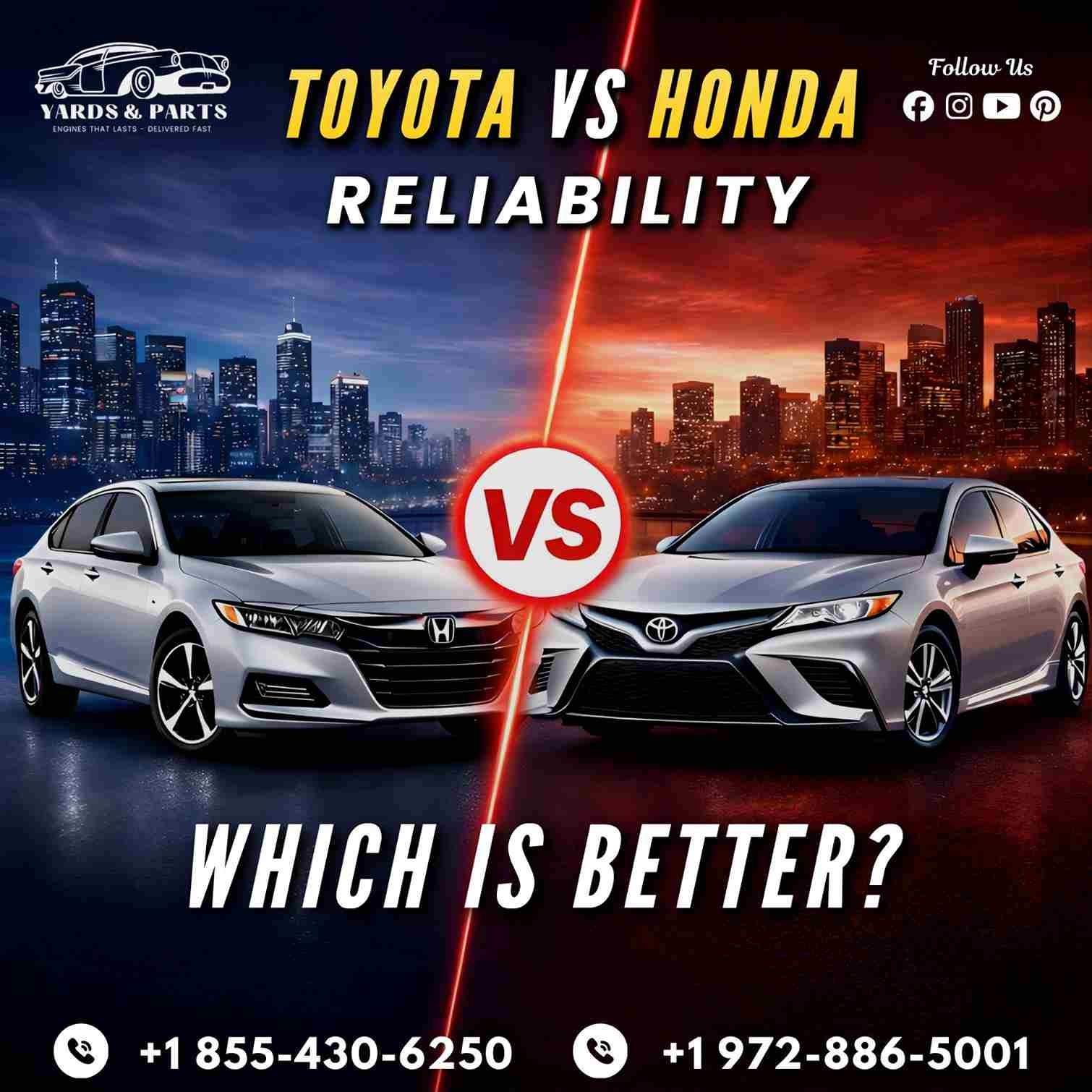
Toyota and Honda are two brands that have made a legacy in the automotive sector, and Toyota vs Honda Reliability is a common topic among car buyers. Both are known for their reliability and performance, offering long-term vehicle durability. People still favor these brands because their maintenance and repair costs are comfortably less compared to other brands available in the market.
We will compare these two brands by looking at real-world examples to help you determine which one is best for your needs and situation. This article will clarify all your doubts regarding Toyota vs Honda Reliability, their engine and transmission reliability of both brands, also their ownership reliability over time, so this article is best for both whether you are looking for a new or a used vehicle.
Why Reliability Matters When Choosing Between Toyota and Honda
So now let us talk about why reliability matters when choosing between Toyota and Honda. Reliability means the car’s efficiency over the long run, resulting in fewer visits to the mechanic for regular maintenance. Reliability also impacts the resale value, as a car known for its dependability will provide a much greater resale value compared to other less reliable cars.
When you are choosing between Toyota and Honda, you have to select the one that is more reliable according to your finance and specific situation, because a reliable car will save you money over time and also reduce a lot of stress. The reliable factor provides peace of mind every morning that you have the best car and can drive it smoothly without any worry, anytime, anywhere.
How We Compare Toyota vs Honda Reliability
There are many ways to compare Toyota versus Honda reliability, so the fair comparison between both these giants must be done by different aspects and different conditions. Let us discuss each one by one. First, we will discuss engine reliability, or the ability of these engines to last for hundreds of thousands of miles.
Then, we will proceed to discuss transmission reliability, whether it is automatic, CVT, or manual. Maintenance intervals are also important how often do these cars need to be serviced, and how complicated are these processes? Repair costs also play a significant part in the ownership experience, how much does it cost to repair these cars? Lastly, we will discuss ownership longevity, how many miles can you realistically get out of a well-cared-for Toyota or Honda?
Toyota Reliability Overview
For decades, Toyota has earned a reputation as a reliable manufacturer of automobiles based on decades’ worth of consistency in quality. Its approach is based on the “kaizen” philosophy of continuous improvement, which is evident in its vehicles built from the ground up with proven working technology rather than relying on cutting-edge untested innovations. In addition, Toyotas have a reputation for having engines that are some of the longest-lasting on the planet. Throughout North America alone, there are many Toyotas with over 300,000 miles and still running strong.
Toyota has a history of conservative engineering that contributes to the reliability of its vehicles by focusing its resources on the time-tested designs rather than creating a new design for a new vehicle every year. For instance, almost all Toyota engines are naturally aspirated, so they have less chance of a failure vs. turbocharged because they have fewer parts. Consequently, Toyota vehicles have a better chance of not having problems for a very long time.
Toyota has always been rated among the top most reliable cars by J.D. Power and Consumer Reports. For instance, the Corolla, Camry, and RAV4 have all been rated as some of the most reliable cars currently being produced, and the reliability of Toyota’s hybrid systems has been proven by the extensive use of Cedar Taxicabs, as many taxi cab owners have opted to purchase/hybrid Toyotas because of their incredible reliability and ability to last for a long time.
But Toyota is not without its flaws. Some of its models have had problems – for instance, some models of the Tacoma had rust issues with the frame, and some of the V6 engines had oil consumption problems. But these are the exceptions rather than the rule.
Honda Reliability Overview
Honda has always been recognized for its engineering prowess and driver-focused designs. Honda started its journey as a motorcycle brand, and this performance-oriented DNA has been carried forward in their cars as well. Honda engines are renowned for being both dependable and exciting to drive – they rev higher and respond better than many other brands out there.
Like Toyota, Honda has a reputation for being reliable over the long term. Honda cars have been known to easily surpass 200,000 miles with regular upkeep. Honda’s VTEC engine series has been known to be extremely durable over the years. Honda’s naturally aspirated four-cylinder engines are simply indestructible, with many owners reporting little to no problems even after years of use.
The reliability ratings of Honda cars from reputable sources are nearly as good as those of Toyota. Cars like Civic, Accord, and CR-V have been found to be extremely reliable. Honda’s manual transmissions have been widely appreciated by car aficionados for their precision and reliability.
However, Honda has had some problems with reliability in the recent past. Honda’s CVT transmissions have had more complaints than Toyotas. This has been particularly true in the older models. Some of Honda’s turbocharged engines have had problems with oil dilution. Honda’s infotainment systems have also been panned for being less reliable and more complicated to use than those of other manufacturers. However, Honda is one of the most reliable car brands out there, but with a few more question marks than Toyota in some ways.
Engine Reliability Comparison – Toyota vs Honda
When it comes to engine reliability, both brands are very good, but there are some subtleties. Toyota engines are built to last as long as possible with as little trouble as possible. They are built conservatively and with proven technology. Honda engines are reliable, but they are built for better performance, which sometimes means a bit more stress on the engine.
Toyota four-cylinder engines, particularly in the Corolla and Camry models, are virtually indestructible. Their V6 engines are also very reliable, although some of the older models had issues with oil consumption. Toyota hybrid systems have been very reliable, with many Prius taxis having well over 500,000 miles on them.
Analyzing Honda’s history, the K-series and L-series engines have a great reputation for exceeding 200,000 miles with just normal maintenance. But the newer Honda models with turbo engines have had some minor issues, like oil dilution problems in some regions. This is not a major reliability concern but is an area for improvement that Honda needs to address.
Talking about engine durability, Toyota has taken a step forward of Honda because Toyota has been playing safe and not venturing into areas that could potentially become problem areas. Honda engines are reliable, but their openness to new technology sometimes leads to problems that take time to fix.
Transmission Reliability – Automatic, CVT, and Manual
Where we notice more substantial differences between these brands is in transmission reliability. Toyota’s automatic transmissions are famous for their reliability. Toyota’s traditional automatic transmissions can last the lifetime of the car if the fluid is changed regularly. Toyota’s CVTs, found in certain models, have been more reliable than many rival brands’ CVT transmissions.
Honda’s manual transmissions are incredible – smooth, accurate, and almost bulletproof. Many car enthusiasts look specifically for Honda manual transmissions because of their excellence. But Honda’s automatic transmissions and CVTs have had more problems reported than Toyota’s. Some earlier Honda CVT transmissions, especially in models such as the Civic and Accord, failed prematurely and shifted jerkily. Honda has since fixed these issues in their transmissions, but the initial results were alarming.
If you’re purchasing a car with a manual transmission, Honda may have the advantage. But if you’re purchasing an automatic or CVT transmission, Toyota’s reputation is better. This is a serious consideration, as repairs to a transmission can be very costly – sometimes thousands of dollars.
Maintenance and Repair Costs – Which Brand Is Cheaper to Own?
Compared with many other high-end car makes/models, both Honda and Toyota maintenance costs are relatively inexpensive to keep up. However, the two companies have some differences. There is little difference overall in terms of maintenance costs for both Honda and Toyota. The average cost for completing regular tasks such as oil changes, tire rotations, and brake services are virtually identical for both makes/models.
The area where the cost may vary is in the cost of spare parts and the number of times the car needs to be repaired. The cost of Toyota spare parts is slightly higher, but the car does not require many repairs. The cost of Honda spare parts is slightly lower, but some models of the car may require frequent repairs, especially those with CVT transmissions.
Both brands have the advantage of having many models on the road, so independent repair shops are familiar with them, and spare parts are easy to find. You won’t have to go to the dealership for most repairs, which keeps the costs low.
In a 10-year ownership experience, the total cost of ownership leans slightly in favor of Toyota, and this is due to fewer surprise repairs. But the difference isn’t drastic, and both brands are among the cheapest cars to own in the long run. Yards and Parts USA frequently gets both brands with high mileage and few serious component failures, which is a testament to their durability.
Model-by-Model Reliability Comparison
When comparing models side by side, the real differences become clearer. In the discussion of Toyota vs Honda Reliability, popular sedans like the Toyota Corolla and Honda Civic often come up first. The Corolla is widely appreciated for its simple engineering and long-lasting engine performance, while the Civic stands out for its balanced mix of efficiency and driving comfort. Both models have strong track records, but when it comes to Toyota vs Honda Reliability, many owners feel Toyota slightly edges ahead in long-term durability.
Moving to midsize sedans, the Toyota Camry and Honda Accord are both dependable choices. The Camry is known for fewer major transmission issues over time, whereas the Accord offers a smoother driving experience with solid engine reliability. In SUVs, the Toyota RAV4 and Honda CR-V are consistent top performers. The RAV4 is praised for lower maintenance costs, while the CR-V is valued for practicality and resale value, making Toyota vs Honda Reliability a close and ongoing comparison for buyers.
Toyota Corolla vs Honda Civic Reliability
The two vehicles Toyota and Honda engine and transmission are both reliable, especially when discussing Toyota vs Honda Reliability. However, the Toyota Corolla has a minor edge in terms of long-term car reliability over the Honda Civic. This is because the Corolla is built with simple and proven technologies, and there have been fewer customer complaints about it than about the Civic.
While the Civic is a reliable vehicle overall, there have been some years that have not had good reliability ratings, particularly for the models that feature continuous variable transmissions (CVTs) and turbocharged engines. Therefore, when comparing Toyota vs Honda Reliability, the Toyota Corolla is the more reliable vehicle of the two, but the Honda Civic has a more exciting driving experience to offer.
Toyota Camry vs Honda Accord Reliability
This one is pretty difficult to write about. Over time, the Camry has proven itself to be a model that is built for long distances and will continue to be reliable, whether you have a V6 or a 4-cylinder engine. Although the Accord has a good reputation as a trustworthy vehicle, there have also been numerous automatic transmission failures in older Accords during the past few years, with transmission failure rates similar to those found with older Civics. Like the Civic, with proper maintenance, both the Accord and Camry will last longer than 200,000 miles; however, due to the lower failure rates of the Camry, Toyotas tend to get far less consumer complaints than Hondas.
Toyota RAV4 vs Honda CR-V Reliability
When it comes to long-term car reliability, the Toyota RAV4 has a huge advantage over its closest rival, the Honda CR-V, especially in discussions about Toyota vs Honda Reliability. Apart from having a far lower number of reported problems compared to the CR-V, the RAV4 has a track record of using similar powertrains that have been used in the past models.
On the other hand, the CR-V also has a great reliability rating; however, some of the older models that used turbo engines and CVTs had more problems compared to the RAV4 models. Therefore, when comparing Toyota vs Honda Reliability, both cars would be great choices, but if it is reliability that you are worried about, then the RAV4 would be the best choice.
Reliability Over Time – 5-Year vs 10-Year Ownership
In the first five years, both Toyota and Honda are exceptional. You will encounter very few problems with either of these vehicles, assuming that you take good care of them. The differences will become more noticeable after the five-year mark.
The Toyotas will maintain their reliability much better with age. When the Toyotas reach 10 years of age, they will have fewer issues than comparable Hondas, particularly with regards to the transmission and some electrical components. The Hondas will remain reliable at this age, but you might experience some minor repairs. This is why Toyota always scores higher in 10-year reliability tests.
Common Reliability Issues in Toyota and Honda Vehicles
Every brand has weaknesses, even the ones perceived as reliable. Be on the lookout for V6 engines having excessive oil consumption from around the early 2010s if considering buying a Toyota. There are also some Tacoma pickups that experienced severe rusting of their frames, and a few Prius models but not many had issues with their inverters.
The main issues that have been found with Honda cars are:
- The CVT transmission found in the mid-2015 Honda Civic/Accord has had issues reported ,although it seems not all cars from this time period are affected, and Honda has fixed many issues.
- The Turbocharged engine oil dilution due to the climate issues of cold temperatures.
- Bugs related to the infotainment systems of newer Honda models this is a very rare issue. It would be a good idea to take into consideration an inspection for the above issues when purchasing a used Honda car.
Final Verdict – Which Is More Reliable, Toyota or Honda?
When assessing the data about Toyota vs Honda reliability, it looks like Toyota just edges Honda in terms of reliability; Toyota has a more conservative design philosophy, tried and tested engines, and has been around for a long- term car reliability. This doesn’t mean that Honda has bad reliability; because Honda also builds great, reliable vehicles to last you for years and years.
If you are trying to get the best chance to have a trouble-free vehicle for more than 10 years, then Toyota’s your best option. If you’re trying to find a vehicle that is fun to drive, reliable, and has a chance of having a few minor issues along the path, then Honda’s a great choice.
Either way, you will receive a vehicle that is going to treat you like gold compared to others, so you can’t go wrong; your choice will just depend on which model you like most, or which model has the features that you will need. Whatever your preference, you will choose one of the most dependable automobile manufacturers in your search for a new car.
You May Also Read: How to Read a Used Engine Inspection Report